

The Notification You Didn't Want to See
One day your community manager pastes a link in Slack: your token has been moved to the Assessment Zone on MEXC, or slapped with a Monitoring Tag on Binance. The price starts dropping within hours. Your Telegram explodes with panic questions.
This is one of the most stressful moments in a crypto project's lifecycle — and it's far more common than most teams publicly admit. Exchanges placed dozens of tokens into assessment and monitoring status throughout 2025 and continue doing so in 2026.
The good news: an Assessment Zone tag is not a death sentence. It is a warning — a structured, time-limited period during which you can demonstrate that your project deserves to stay listed. Many projects have had their monitoring tags removed after making the right improvements.
This guide walks you through exactly what these zones are, how they work across the major exchanges, and what your team needs to do right now to get out.
Table of Contents
- What Is an Assessment Zone?
- How Each Major Exchange Handles It
- Why Tokens End Up There: The Root Causes
- The Escalation Path: From Warning to Delisting
- The Recovery Playbook: 7 Steps to Get Out
- How to Avoid Assessment Zones in the First Place
- Frequently Asked Questions
What Is an Assessment Zone?
An Assessment Zone (also called a Monitoring Tag, ST Warning zone, or Review Zone depending on the exchange) is a conditional listing status that signals a token is under close scrutiny and may be delisted if specific performance criteria are not met within a defined period.
Think of it as probation for your token. The exchange is saying: "We have concerns. Show us you're serious, or we'll remove you."
Assessment zones serve two purposes for exchanges:
- They protect retail users by flagging high-risk tokens with explicit warnings
- They give legitimate projects a structured window to course-correct before the final delisting decision
The key distinction: being placed in an assessment zone is not the same as being delisted. There is time, and there is a path forward.
How Each Major Exchange Handles It
Binance — Monitoring Tag
Binance's equivalent is the Monitoring Tag, one of the most widely publicized mechanisms in the industry. When a token receives this tag, users must pass a dedicated quiz before trading and must retake it every 90 days.
What Binance evaluates:
- Trading volume and market liquidity
- Team commitment and responsiveness
- Development activity (GitHub commits, product updates)
- Network security and stability
- Public communication and community transparency
- Tokenomics integrity (no unjustified supply increases)
- Regulatory compliance
- Response to periodic due diligence requests
Binance conducts periodic reviews during the monitoring period. If a project demonstrates sustained improvement across these criteria, the Monitoring Tag can be removed. If it doesn't, the token is delisted.
Recent examples include tokens like FARM, HIGH, MLN, RESOLV, SYS, TRU, and VELODROME being added to the Monitoring Tag list in April 2026, while other projects like ZEC have had their tags successfully removed after improvements.
MEXC — Assessment Zone + ST Warning
MEXC has one of the most structured and transparent multi-stage processes:
Stage 1: Assessment Zone
The token is moved to a special zone with elevated scrutiny. The project has a defined evaluation window to make improvements.
Stage 2: ST Warning
If the project fails to demonstrate improvements by the end of the assessment period, MEXC places an "ST" (Special Treatment) warning label on the trading pair.
Stage 3: Delisting
Once the ST tag is applied, delisting typically follows within 3 days.
MEXC's specific triggers for entering the assessment process include:
- Fewer than 100 wallet holders with balances over $5
- Average daily holdings of project token holders below 50,000 USDT for 30 consecutive days
- Average daily buy-sell spread exceeding 2% for 15 consecutive days
- Price deviation from other CEXs exceeding 15% over a 15-day period
Other Exchanges
Most major CEXs operate similar systems under different names. Gate.io, KuCoin, OKX, and Bybit all have internal review processes that can trigger restricted trading, user warnings, or staged delisting. The underlying criteria are remarkably consistent across the industry: liquidity, development activity, team responsiveness, and community health.
Why Tokens End Up There: The Root Causes
Understanding why a token enters an assessment zone is the first step to getting out. The causes generally fall into five categories:
1. Liquidity Collapse
Thin order books, wide spreads, and low daily volumes are the most common triggers. This usually happens after a bear cycle, post-TGE sell pressure, or when market makers exit positions.
2. Development Inactivity
Exchanges monitor GitHub commits, product releases, and protocol upgrades. A quiet repository for several months is a red flag that sends an automatic signal to exchange compliance teams.
3. Community Attrition
Declining holder counts, falling social engagement, and shrinking active user bases all feed into assessment algorithms. Exchanges want to see that real people are using and holding your token.
4. Team Communication Breakdown
Failure to respond to exchange due diligence requests, missing AMA commitments, or going dark on official channels are taken seriously. Exchanges need active partners, not ghost projects.
5. Tokenomics Red Flags
Unexplained increases in circulating supply, insider wallets dumping, or major shifts in token allocation without community notice create immediate compliance concerns.
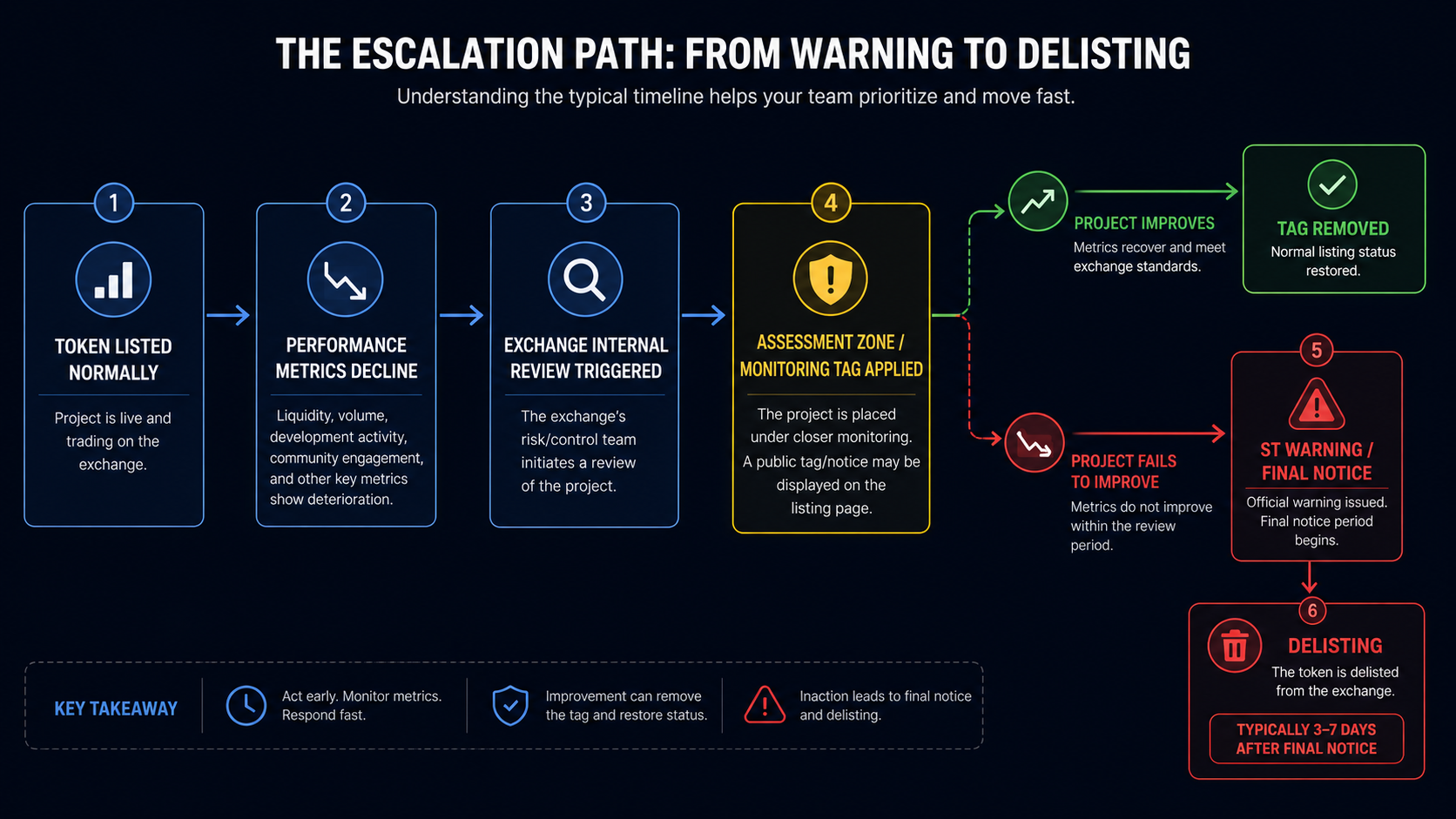
The window between Assessment Zone entry and final delisting varies by exchange — Binance tends to run multiple review cycles over weeks or months, while MEXC's ST Warning gives you roughly 3 days once triggered.
Act immediately upon receiving any assessment zone notification.
The Recovery Playbook: 7 Steps to Get Out
Step 1: Contact Your Exchange Liaison Within 24 Hours
This is non-negotiable. Every exchange that runs an assessment process has a business development or listing contact. Reach out directly, acknowledge the situation, and ask for:
- The specific criteria being evaluated
- The timeline for the current review cycle
- A clear list of what improvements would satisfy their requirements
Most exchanges prefer to keep good projects listed. They are not adversaries — treat this as a business relationship that needs repair.
Step 2: Diagnose Your Metrics Honestly
Pull the data before you make any commitments. Check:
- On-chain: daily active addresses, holder count trends, average wallet size, token velocity
- Exchange: 24h volume, order book depth, bid-ask spread, price vs. other venues
- Development: GitHub commits per week, last protocol release, open issues
- Community: Telegram/Discord daily active users, Twitter engagement rate, weekly new followers
Identify which 2–3 metrics are the furthest below exchange thresholds. These become your sprint priorities.
Step 3: Revive Development Activity Publicly
Even if your core protocol is mature, exchanges need to see visible signs of life. Ship something: a minor version update, a security audit publication, a new integration announcement, a testnet deployment. Then communicate it clearly across all channels and directly to your exchange contact.
The goal is to make it obvious to a compliance analyst that this project is alive and being actively developed.
Step 4: Address Liquidity Directly
If your spreads are wide or depth is thin, you have a few options:
- Engage a market maker — several professional market-making firms work with mid-cap projects on short notice. Even a 30-day engagement can normalize spread metrics.
- Run a trading incentive campaign — volume contests and fee rebates can attract organic trading activity, but ensure they comply with the exchange's terms.
- Reach out to the exchange's liquidity support programs — Binance, OKX, and MEXC all have programs that can support qualified projects with liquidity tools.
Do not attempt to fake volume through wash trading. Exchanges have sophisticated detection, and discovery will trigger immediate delisting.
Step 5: Run a Real Community Activation Campaign
Holder count and active user metrics require actual on-chain activity. Strategies that work:
- Staking/locking campaigns — incentivize existing holders to lock tokens, which increases visible conviction metrics
- Ecosystem grant rounds — announce a grant program for builders using your protocol, which generates real on-chain transactions
- Airdrop to existing community members — a retroactive distribution to active wallets increases holder counts and generates organic discussion
- AMA series — coordinate with the exchange directly for an AMA in their official communities; this signals partnership health and drives new holders
Step 6: Re-establish Transparent Public Communication
If your team has been quiet, now is the time for a full transparency push. Publish:
- A detailed project update covering the last 90 days of development
- An honest assessment of current challenges and the roadmap to address them
- A tokenomics review if supply or distribution has changed
- A clear communication cadence commitment (e.g., weekly updates for the next 60 days)
Authenticity matters here. Communities and exchange compliance teams can both tell the difference between a real revival and a PR campaign designed to tick boxes.
Step 7: Document Everything and Submit a Formal Review Request
Once you have 2–4 weeks of improved metrics, compile a formal brief for your exchange contact:
- Before/after charts for every key metric
- Links to all public communications and development activity
- Summary of community growth initiatives
- Commitment statements for ongoing performance
Request a formal review rather than waiting for the next automated assessment cycle. A proactive, well-documented submission significantly increases the chances of tag removal.
How to Avoid Assessment Zones in the First Place
For teams that are currently listed and want to prevent ever entering an assessment zone, the principles are straightforward — but require consistent execution.
Maintain minimum viable liquidity at all times. Budget for market-making as a core operational expense, not a luxury. A 30-day market-making contract is far cheaper than a delisting and relisting process.
Ship on a regular cadence. It doesn't need to be a major protocol upgrade every month. Developer updates, audit reports, integration announcements, and ecosystem news all contribute to visible development activity.
Monitor your exchange metrics proactively. Most exchanges provide API access to your token's trading data. Set up automated alerts for volume drops, spread widening, or holder count declines before they become exchange-level concerns.
Respond to exchange communications immediately. Exchanges send periodic due diligence questionnaires. Answer them promptly and thoroughly. A non-response is interpreted as a red flag.
Maintain multi-exchange presence. Being listed on multiple reputable exchanges provides redundancy and signals market confidence. It also means that a single exchange's assessment process doesn't represent an existential threat to your token's liquidity.
Build holder diversification into your token distribution strategy. Projects with concentrated token distribution — few wallets holding large portions — are more vulnerable to holder count metrics. Design your TGE, airdrop, and community distribution to create broad, genuine ownership.
Frequently Asked Questions
Does an Assessment Zone always lead to delisting?
No. Many projects successfully exit assessment zones and have their monitoring tags removed. The outcome depends on how quickly and effectively the project addresses the underlying criteria.
How long does the assessment period last?
It varies by exchange. Binance conducts periodic reviews with no fixed timeline — tags can last weeks or months. MEXC's assessment period has a defined end date, after which the ST Warning is applied if improvements haven't been made.
Can we apply for relisting if we get delisted?
Yes, but the process is significantly harder than maintaining your existing listing. Most exchanges have a waiting period, require substantially improved metrics, and apply stricter standards to previously delisted projects. Prevention and recovery are far preferable to relisting.
Does a Monitoring Tag on one exchange trigger assessments on others?
Not automatically, but it can attract attention. Exchange compliance teams monitor each other's listing decisions. A monitoring tag on Binance may prompt other exchanges to review your listing proactively.
Should we publicly announce our assessment zone status?
Yes. Attempting to hide it will backfire — the information is public on the exchange, and your community will find out. A proactive, honest announcement that includes your recovery plan will do far less damage to community confidence than the appearance of a cover-up.
Final Thoughts
An Assessment Zone placement is a stress test — for your operations, your team's responsiveness, and your community's resilience. Projects that treat it as a wake-up call and execute the recovery playbook systematically come out stronger. Projects that ignore it, panic, or try to game their way through don't.
The exchanges that run these programs are not trying to destroy your project. They are trying to maintain platform quality for their users. Meet them as partners, address the root causes honestly, and use this moment to build the operational discipline that will protect your token's listing status for the long term.
Got the Assessment Zone Tag? EasyMM Can Help You Get Out.
Executing the recovery playbook above takes time your team may not have — and liquidity recovery, in particular, requires professional infrastructure that most projects don't have in-house.
EasyMM specializes in exactly this situation. We work with crypto projects that have entered Assessment Zones or received Monitoring Tags, providing the market-making, liquidity management, and exchange strategy support needed to meet exchange criteria and get the tag removed.
What EasyMM does for projects in Assessment Zones:
- Liquidity restoration — We normalize your order book depth and bid-ask spreads to meet exchange thresholds, fast
- Volume strategy — Sustainable, compliant trading activity that satisfies exchange metrics without triggering wash-trade detection
- Exchange liaison support — We've worked with major exchanges and understand what their compliance teams actually need to see
- Metrics monitoring — Real-time tracking of every KPI that matters for your review cycle, so you're never caught off guard
- Recovery timeline management — We build a structured action plan around your specific assessment window, so every day counts
The clock starts when the tag goes on. The faster you act, the more options you have.
→ Talk to EasyMM about your assessment zone situation
This guide is for informational purposes. Always refer to the official documentation and listing policies of each exchange, as criteria and processes are updated regularly.