

Quick Answer: EasyMM helps crypto projects avoid MEXC's ST (Special Treatment) zone by continuously managing order book depth, spreads, and trading volume — the exact metrics MEXC uses to trigger ST warnings — so tokens never breach the thresholds. For projects already in the Assessment Zone, EasyMM runs a rapid-recovery process that restores liquidity and trading activity before the evaluation period ends, helping them exit clean with no ST tag.
Key takeaways
- MEXC's Assessment Zone is a 30–60 day evaluation period for newer or recommended-listing tokens; failing it triggers an ST (Special Treatment) warning tag.
- ST tags are usually triggered by liquidity failures — wide spreads, thin order book depth, falling holder counts — not by weak fundamentals.
- Once tagged, a project can be delisted within days if it doesn't meet at least four of MEXC's evaluation criteria during the observation period.
- EasyMM prevents ST tags through continuous, monitored market making, and runs rapid-recovery interventions for projects already inside the Assessment Zone.
- Two EasyMM-supported projects were recently confirmed by MEXC as cleared from the Assessment Zone with no ST tag applied.
Key takeaways
- MEXC's Assessment Zone is a 30–60 day evaluation period for newer or recommended-listing tokens; failing it triggers an ST (Special Treatment) warning tag.
- ST tags are usually triggered by liquidity failures — wide spreads, thin order book depth, falling holder counts — not by weak fundamentals.
- Once tagged, a project can be delisted within days if it doesn't meet at least four of MEXC's evaluation criteria during the observation period.
- EasyMM prevents ST tags through continuous, monitored market making, and runs rapid-recovery interventions for projects already inside the Assessment Zone.
- Two EasyMM-supported projects were recently confirmed by MEXC as cleared from the Assessment Zone with no ST tag applied.
The Problem: One Bad Week Can Get a Token Tagged for Delisting on MEXC
For any project listed on MEXC, there's a quiet but constant risk running in the background: the exchange's ST Rules. MEXC introduced these rules to protect users and filter out projects that can't sustain healthy trading conditions — but in practice, they put founders on a clock they often don't even know is ticking.
Here's how the MEXC Assessment Zone works. Tokens that are newer, smaller, or recommended by the community for listing often land in the Assessment Zone rather than going straight to the Main or Innovation Zone. Tokens moved into the Assessment Zone get a 30-day evaluation window; tokens originally listed there get 60 days. During that window, MEXC tracks a specific set of metrics: price stability relative to the listing price, holder count, daily trading volume, buy-sell spread, and price divergence from other exchanges.
If a project doesn't hold up, it gets an MEXC ST (Special Treatment) tag. According to MEXC's published ST Warning Rules, that tag can be triggered by any of the following:
- Token price falling below 10% of its initial listing price
- A decline of more than 60% within the first three days of listing
- Fewer than 100 users holding at least $5 worth of the token
- An average daily buy-sell spread above 2% for 15 consecutive days
- A price gap of more than 15% versus other exchanges, sustained over 15 days
- Average daily holdings across token holders dropping below 50,000 USDT for 30 consecutive days
Once a project is hit with the ST tag, the clock gets a lot shorter. MEXC gives tagged projects a brief observation period — and if the project doesn't meet at least four of the evaluation criteria, the relevant trading pair gets suspended and delisted within days. For a project, that's not just a label. It's a direct hit to investor confidence, a freeze on new deposits, and in many cases, the end of the token's life on one of the largest exchanges by trading volume in the world.
The frustrating part: most projects don't get tagged because their fundamentals are weak. They get tagged because nobody is actively managing the order book. Spreads widen, buy-side depth disappears overnight, holder thresholds slip — and by the time the team notices, MEXC has already flagged the pair.
Why Projects End Up in the MEXC ST Zone
Founders are usually focused on product, partnerships, and community — not on minute-by-minute order book health. But MEXC's thresholds are mechanical and unforgiving. A token can have a strong community and a real use case and still get tagged simply because:
- There wasn't enough resting liquidity on both sides of the book to absorb normal volatility
- The team treated market making as a "set it and forget it" service rather than continuous, adaptive management
- Nobody was tracking the specific metrics MEXC uses for evaluation, so warning signs went unnoticed until the tag was already applied
This is the gap EasyMM is built to close.
How EasyMM Helps Projects Avoid and Escape the MEXC ST Zone
EasyMM works as a long-term market making partner rather than a one-off liquidity vendor, with two relevant points of intervention:
1. Prevention — keeping projects out of the Assessment Zone in the first place. Through continuous, AI-assisted order book management and 24/7 monitoring, EasyMM maintains the buy-side depth and tight spreads that MEXC's ST Rules are specifically checking for. Instead of reacting to a warning, the goal is to never trigger one — by tracking the same metrics MEXC uses internally (spread, depth, cross-exchange price parity, holder activity) and adjusting strategy before any threshold is breached.
2. Recovery — getting projects out of the Assessment Zone or ST tag once they're in it. When a project is already inside the Assessment Zone or has received an ST warning, EasyMM runs a rapid-intervention recovery process: rebuilding order book depth, tightening spreads, restoring trading volume, and aligning pricing with the rest of the market — all within the evaluation window the exchange provides. This is the difference between a project quietly getting delisted and a project clearing the assessment with a clean bill of health.
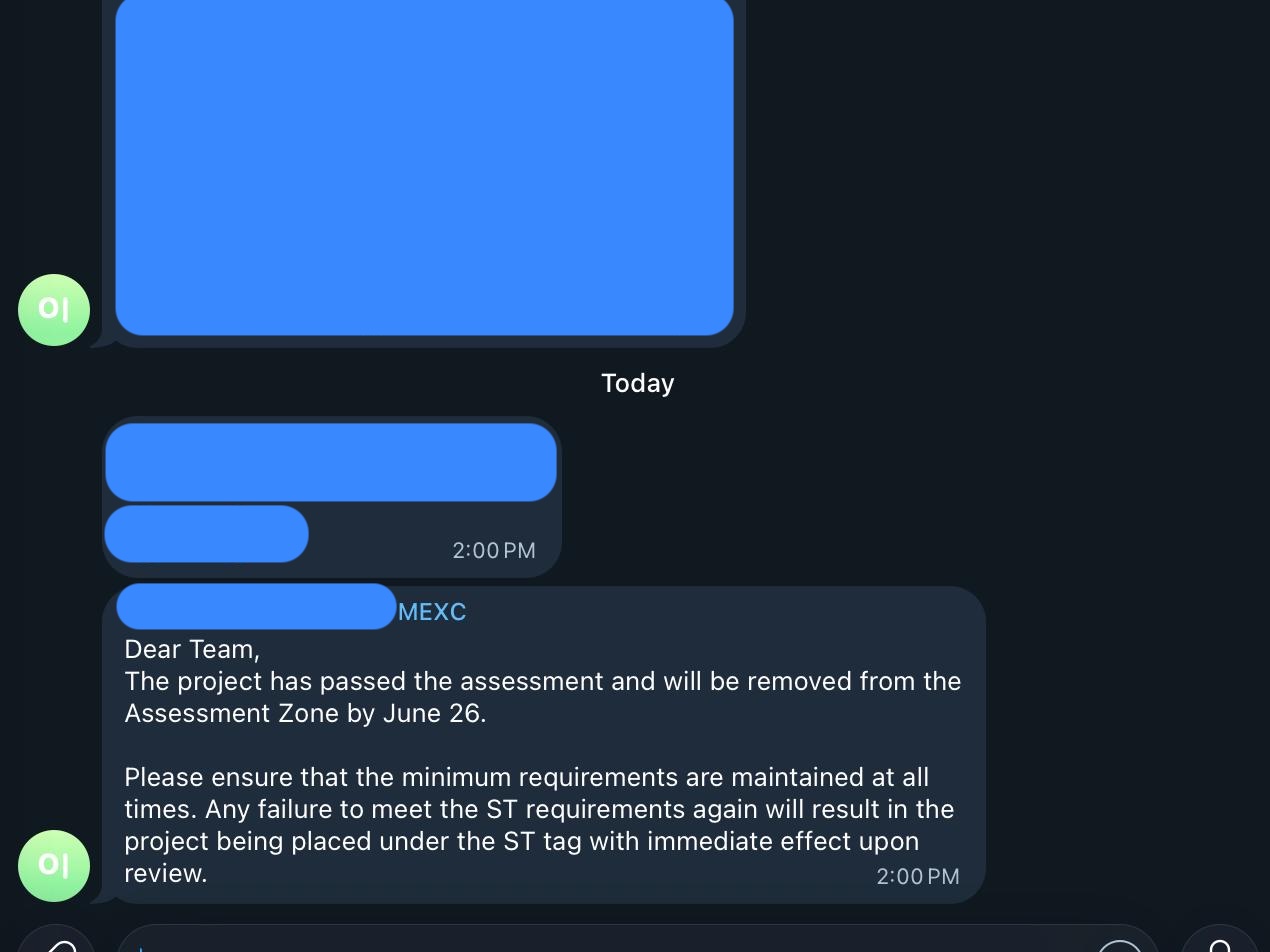
This approach recently played out with two of EasyMM's clients on MEXC. Both projects had been placed in the Assessment Zone; both came through the evaluation and were confirmed by MEXC to be moved out by June 26, with no ST tag attached. The mechanism was the same one described above — sustained healthy market conditions, monitored and adjusted in real time, through the entire assessment window.
.jpg)
"Most projects don't get tagged because the token is weak — they get tagged because nobody was watching the order book that week. Our job is to make sure that week never happens." — Daniil Kozin, CEO | EasyMM
Real Results: Our Projects Exiting the ST Zone
This isn't a theoretical playbook — it's what we do for clients. Below is the actual confirmation from MEXC's team after one of our recent assessment cycles.
The Takeaway
MEXC's ST Rules aren't designed to be punitive — they're designed to filter out tokens that can't sustain real trading activity. But "real trading activity" doesn't happen by accident. It requires deliberate, continuous market making that treats liquidity as infrastructure, not an afterthought.
For projects already listed on MEXC — or about to be — the smartest move isn't to find out about the Assessment Zone after getting the warning email. It's to have a partner already managing the order book before MEXC ever needs to send one.
FAQ
What is the MEXC Assessment Zone? The Assessment Zone is an intermediate listing category on MEXC for newer or community-recommended tokens. Tokens spend 30 days there if moved in from another zone, or 60 days if originally listed there, while MEXC evaluates price stability, holder count, volume, and spread.
What triggers an ST tag on MEXC? An ST (Special Treatment) tag is triggered when a token's price drops below 10% of its listing price, falls more than 60% in the first three days, has fewer than 100 qualifying holders, runs an average spread above 2% for 15 days, diverges more than 15% from other exchanges for 15 days, or averages below 50,000 USDT in daily holder balances for 30 days.
What happens after a token gets an ST tag? The project enters an observation period. If it meets at least four of MEXC's evaluation criteria, the tag can be removed after a short window. If not, the trading pair is suspended and the token is delisted, typically within days.
How can a project avoid the MEXC ST zone? The most reliable way is continuous, professional market making — maintaining tight spreads, deep order books on both sides, and stable holder activity so none of MEXC's automatic triggers are hit.
Can a project recover after entering the Assessment Zone or getting an ST tag? Yes. Projects can pass the evaluation and move to the Innovation Zone if they restore healthy liquidity and trading metrics before the assessment period ends — which is exactly the kind of rapid intervention a dedicated market maker like EasyMM provides.